
PuneCulture
"Curating experiences..."
Discover Pune's 1,200-year history — from ancient Rashtrakuta copper plates to the mighty Maratha Empire, Peshwa golden age, and the British colonial era.

"To know Pune is to know the beating heart of the Deccan — a city where ancient copper plates, Maratha swords, Peshwa palaces, and colonial bungalows all share the same dust."
Few cities in India carry as layered a history as Pune. Nestled in the western Deccan Plateau at the confluence of the Mula and Mutha rivers, this city has witnessed the rise and fall of empires, the birth of revolutionary ideas, and a transformation from a quiet agricultural settlement into one of India's foremost metropolises. Whether you are a history enthusiast, a traveller, or a student of Indian civilisation, Pune's story is essential reading.
This blog covers Pune history facts chronologically — from its earliest archaeological evidence in the 8th century CE all the way to its post-independence emergence as a tech and education powerhouse.
Before diving into dynasties and battles, it is worth understanding why the city is called Pune at all. The Pune Gazetteer explains that the word "Pune" derives from the Sanskrit Punya, meaning "holy." The confluence (sangama) of two rivers — the Mula and the Mutha — was considered sacred in Hindu tradition, giving rise to the name Punyanagari, or "the holy city."
Over the centuries, the settlement was referred to by several names: Punnaka, Punaka Vishaya, Punya Vishaya, Punakawadi, and eventually Kasbe Pune. During British rule, the city was anglicised to Poona in 1857, a name that remained official until 1978, when it was formally changed back to Pune.
Pune's recorded history begins with two remarkable copper plates. Dated 758 CE and 768 CE, these archaeological finds reveal that the region was under the rule of the Rashtrakuta dynasty. A copperplate charter unearthed near Talegaon — dated 786 CE — records a land grant by Krishnaraj of the Rashtrakuta line, situating it in the district of Punnat, bounded by the Khadir Hills to the south and the Mula River to the north.
At this time, Pune was not a city in any modern sense. It was a modest agricultural settlement on the banks of the Mula and Mutha rivers, referred to as Punnaka or Punaka Desha. The famous Pataleshwar rock-cut cave temple, carved from a single basalt rock and dedicated to Lord Shiva, dates to this very era — and it still stands today on Jangli Maharaj Road, one of Pune's most visited ancient monuments.
After the Rashtrakutas, the Yadava dynasty rose to prominence across the Deccan. By the 9th century, Pune — then known as Punaka Wadi or Punewadi — was part of the Yadava kingdom centred at Devagiri (modern Daulatabad). Scattered remnants of temples built in the Hemadpanti style — characterised by black basalt masonry with no mortar — survive at sites like Bhamburda and Nageshwar in Pune, attesting to Yadava architectural influence.
The Yadavas were the last Hindu dynasty to rule over Pune in the early medieval period. In 1295 CE, the army of Ala-ud-din Khilji, later Sultan of Delhi, defeated the Devagiri Yadavas. Though the Yadavas were permitted to rule briefly as a tributary state, they were soon superseded entirely.
By 1317 CE, the Khilji dynasty brought Pune firmly under the control of the Delhi Sultanate, followed by the Tughlaqs. Through this turbulent medieval period, Pune passed through successive hands — from the Chalukyas to the Rashtrakutas, to the Western Chalukyas, then to the Yadavas, and finally to the Deccan Sultanates.
The city was later absorbed into the Bahmani Sultanate, and subsequently into the Nizam Shahi of Ahmednagar — the sultanate that would, ironically, hand Pune to its most famous rulers: the Marathas.
Pune's transformation from a modest kasba (township) to a centre of imperial power began in the early 17th century. In 1595 or 1599, Maloji Bhosale — grandfather of the future Maratha king Shivaji — was granted the title of Raja by Bahadur Nizam Shah II of Ahmednagar. On the recommendation of the Nizam's powerful minister, Malik Ambar, Maloji received the jagir (fiefdom) of the Pune and Supe parganas.
However, Pune's fortune nearly ended before it properly began. In 1630–31, the general Murar Jagdeo Pandit of the Adil Shahi sultanate of Bijapur razed Pune to the ground, using ass-drawn ploughs as a symbolic act of total dominance. The city was desolated.
It was Dadoji Kondadeo, the able administrator appointed by Shahaji Bhosale, who rebuilt Pune from the rubble. He rejuvenated the city's infrastructure and, crucially, constructed the Lal Mahal (Red Palace) in 1630 CE — a palace built to house Shahaji's wife Jijabai and young son Shivaji. It is said that Jijabai herself commissioned the construction of the Kasba Ganapati temple, whose idol became — and remains to this day — the Gramadevata (presiding deity) of the city.
No account of Pune history facts is complete without a detailed discussion of Chhatrapati Shivaji Maharaj. While born at Shivneri Fort, Shivaji spent his critical formative years in Pune, growing up within the Lal Mahal under the watchful guidance of his mother Jijabai and Dadoji Kondadeo.
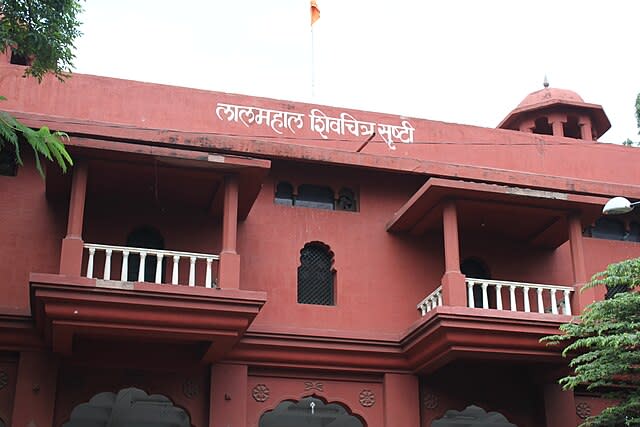 The recreated Lal Mahal in Pune, where Shivaji spent his childhood
His first marriage to Saibai took place at the Lal Mahal on 16 May 1640.
It was from Pune that Shivaji launched his audacious campaigns. In 1645, he captured Torna Fort — the first fort to fall under his command, and the symbolic beginning of the Maratha Empire. Shivaji subsequently oversaw urban development in Pune, constructing the Guruwar, Somwar, and Mangalwar Peths (market wards), expanding the city's commercial and residential footprint.
One of the most dramatic episodes in Pune's history took place at the Lal Mahal itself. The Mughal general Shaista Khan — Aurangzeb's uncle — occupied Pune and even moved into Shivaji's own childhood home. In a daring midnight raid in 1663, Shivaji infiltrated the palace and attacked Shaista Khan's chambers. Khan barely escaped through a window, but not before Shivaji cut off three of his fingers. Pune was recaptured and remained primarily under Maratha control.
Shivaji was formally crowned Chhatrapati (Sovereign King) in 1674, founding the Maratha Empire.
After Shivaji's death, control of Pune shifted frequently. The decisive turning point came in 1714, when Maratha ruler Chhatrapati Shahu appointed Balaji Vishwanath, a Chitpavan Brahmin, as his Peshwa (Prime Minister). Pune and its surrounding areas were granted to this new Peshwa leadership, inaugurating the Peshwa Era.
In 1720, Baji Rao I (Bajirao Ballal) succeeded his father as Peshwa at the remarkably young age of 20. Historians regard him as one of the greatest military generals of the 18th century. He relocated his administration from Saswad to Pune in 1728 and began the construction of the iconic Shaniwar Wada palace.
Bajirao's son, Nanasaheb Peshwa (Balaji Bajirao), who ruled from 1740 to 1761, further expanded the city. He constructed landmarks like the Parvati Temple complex and new wards: Nana Peth, Narayan Peth, Rasta Peth, and Sadashiv Peth.
This golden age, however, came to a devastating end at the Third Battle of Panipat in January 1761. The Maratha forces suffered a crushing defeat at the hands of Ahmad Shah Durrani, ending the era of unbroken Maratha supremacy.
The final blow came from the British East India Company. In the Third Anglo-Maratha War, the Peshwas were defeated at the Battle of Khadki (Kirkee) near Pune in 1817. By 1818, all Maratha territories were annexed to British India.
Pune was placed under the Bombay Presidency, and the British built a massive military cantonment. Pune became the monsoon capital of the Bombay Presidency — drawing British elites during the rainy season. The Aga Khan Palace — built in 1892 — gained enormous historical significance as the prison where Mahatma Gandhi and Kasturba Gandhi were interned during the Quit India Movement.
 Aga Khan Palace, Pune - the Italian arches hiding a revolutionary history
British rule also catalysed Pune's development as a seat of modern education:
Pune also birthed towering reformers. Mahatma Jyotirao Phule and Savitribai Phule launched India's first school for girls here. Bal Gangadhar Tilak used Pune as his headquarters, transforming the Ganeshotsav festival into a platform for mass political mobilisation.
After Indian independence in 1947, Pune entered an era of rapid transformation:
By the 1990s, the city emerged as a major destination for information technology and engineering firms. In the 2000s, multinational automobile companies set up facilities in Chakan and Talegaon. Today, Pune is consistently ranked among India's top IT and technology centres, while its dozens of colleges retain its status as the "Oxford of the East."
| Period | Key Event | |---|---| | 758–768 CE | Copper plates confirm Rashtrakuta rule over "Punaka Vishaya" | | 8th Century CE | Pataleshwar cave temple constructed | | 1595/1599 | Maloji Bhosale granted jagir of Pune by Nizam Shahi | | 1630 | Pune razed by Adil Shahi forces; Lal Mahal built | | 1645 | Shivaji captures Torna Fort | | 1663 | Shivaji's night raid on Shaista Khan at Lal Mahal | | 1730 | Shaniwar Wada palace completed | | 1761 | Third Battle of Panipat — decline of Peshwa power | | 1817–1818 | British defeat Peshwas at Battle of Khadki; Pune annexed | | 1848 | Savitribai and Jyotirao Phule open first girls' school | | 1873 | Rules of badminton first drawn up in Pune | | 1892 | Tilak launches public Ganeshotsav | | 1932 | Poona Pact signed between Ambedkar and Gandhi | | 1949 | Savitribai Phule Pune University established |
From the Rashtrakuta copper plates of the 8th century to the Peshwa splendour of Shaniwarwada, from the social revolutions of Savitribai Phule to the IT campuses of the 21st century, Pune has consistently been a city at the forefront of change.
Understanding these Pune history facts is an invitation to walk through the city's ancient lanes with new eyes — to see in every temple, fort, and wada a chapter of a story that continues to unfold.
The Queen of the Deccan endures, and her history is still being written.