Chhatrapati Shivaji Maharaj: The Man Who Gave Pune Its Soul
From his boyhood years in Pune's Lal Mahal to the coronation at Raigad that shook the Deccan — the complete story of Chhatrapati Shivaji Maharaj and why Pune is inseparable from his legend.

Chhatrapati Shivaji Maharaj: The Man Who Gave Pune Its Soul
Before the forts. Before the coronation. Before the empire — there was a boy growing up in Pune's Lal Mahal, listening to his mother's stories and staring at the hills.
Category: History | Era: 1630–1680 | Location: Pune, Maharashtra
To walk through the lanes of Kasba Peth is to walk in the shadow of Chhatrapati Shivaji Maharaj. He grew up here. He prayed here. He gathered his first followers here. And from here, from this one small corner of the Deccan, he launched an idea that would eventually become an empire spanning most of the Indian subcontinent.
Shivaji Maharaj was not born a king. He became one — through strategy, courage, relentless will, and an extraordinary ability to inspire the ordinary people around him. His story is, in many ways, Pune's story.
Birth at Shivneri: A Legend Arrives
On 19 February 1630, at the fortified hill of Shivneri Fort near Junnar — some 90 km northeast of Pune — Jijabai gave birth to a son. She named him Shivaji, after the local goddess Shivai. The name carried a prayer: that this child would be as fierce, as protecting, and as enduring as the goddess herself.
The Lal Mahal Years: Pune's Role in Shaping a King
When Shivaji was roughly five years old, his mother Jijabai brought him to Pune, gifted to their family by the Adilshah as a jagir (feudal grant). They settled in the Lal Mahal — the Red Palace — built for them in the heart of present-day Kasba Peth.
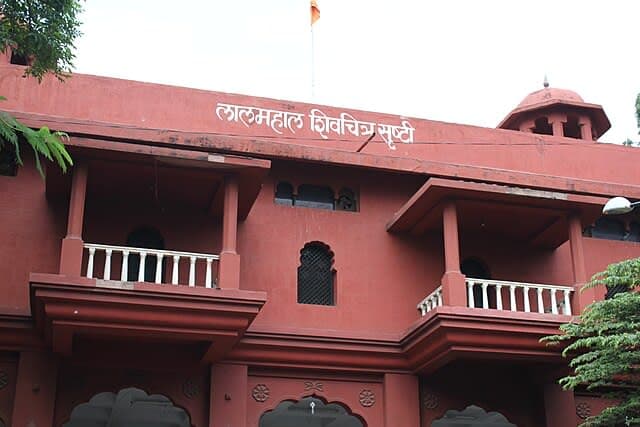 Lal Mahal, Pune — the childhood home of Chhatrapati Shivaji Maharaj in Kasba Peth
The Lal Mahal in Kasba Peth, Pune — rebuilt on the original site where Shivaji Maharaj spent his formative years.
It was here in Pune that the boy who would become king truly came alive. While his father Shahaji served distant sultans, Jijabai — fierce, brilliant, and deeply patriotic — became Shivaji's whole world. Every evening, she told him stories from the Ramayana and Mahabharata — not as mythology, but as manuals of leadership, justice, and duty.
She pointed at the forts in the surrounding hills and said: those should belong to us.
He believed her.
His other great teacher was Dadoji Kondadev, the administrator appointed by his father, who organized Pune's revenue, introduced reforms in the village system, and trained the young Shivaji in horseback riding, swordsmanship, and military strategy.
The streets of Kasba Peth, the fortified ridge of Sinhagad visible from the city, and the Mula-Mutha riverbanks were his classroom. He was not raised in a palace bubble — he spent time with Mavalchi boys: the farmers' and shepherds' sons of the Sahyadri foothills who would later become his elite fighting force, the Mavalas.
The Sacred Oath: Raireshwar, 1645
At age 17, something crystallized in Shivaji that had been building for years. He gathered his closest Mavala companions at the Raireshwar Temple, southwest of Pune in the Sahyadri hills.
Each man pressed his bleeding thumb to a document. The words they swore upon would echo across centuries:
"Hindavi Swarajya — self-rule for the people of this land."
This was not a rebellion against any single ruler. It was a declaration of purpose. Shivaji did not simply want to win battles; he wanted to build a state — with law, administration, a navy, cavalry, and a system of justice that respected the dignity of ordinary people.
Fort by Fort: The Map Redrawn
What happened next was one of the most remarkable military campaigns in Indian history. Beginning in 1646, Shivaji systematically captured fort after fort from the Adilshah of Bijapur.
Torna Fort fell first — a night assault by barely 2,000 Mavalas against a garrison twice their size. The 16-year-old had struck without warning, from an angle the enemy never expected.
With treasure found inside, he immediately began constructing Rajgad Fort — his command center and early capital. He wasn't just taking property. He was building infrastructure for a state.
Then came Kondana (Sinhagad), Purandar, Chakan, Jawali, and dozens more. Each fort was repaired, garrisoned, and integrated into a military network across the Sahyadris.
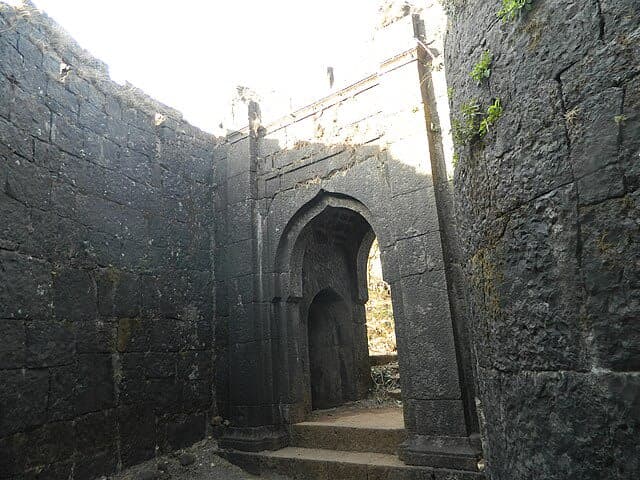 Torna Fort gate — the first military conquest of Shivaji Maharaj
The gate of Torna Fort — captured in 1646, this was the opening act of Shivaji's Swarajya campaign.
The Battle of Pratapgad: Afzal Khan, 1659
By 1659, the Adilshah had seen enough. He dispatched Afzal Khan — his most feared general, a giant of a man known for psychological terror as much as military force — with an army of 10,000 soldiers to crush Shivaji once and for all.
Both sides agreed to a supposedly neutral meeting near Pratapgad Fort. They met alone in a tent.
What exactly happened inside is debated by historians. But the outcome is not: Afzal Khan died that day, his army collapsed in confusion, and Shivaji's decisive victory reverberated across the entire Deccan. The Adilshah's aura of invincibility was shattered. The Maratha empire had its first great legend.
"Afzal Khan came to destroy a king. He left having created a legend."
The Agra Escape: 1666
In 1666, at the insistence of the Mughal Emperor Aurangzeb, Shivaji traveled to Agra for a peace summit. Instead, he was placed under house arrest — Aurangzeb's attempt to neutralize the Maratha threat quietly.
What followed is one of history's most audacious escapes. Shivaji feigned illness, organized the smuggling of himself and his son Sambhaji out of the heavily guarded mansion in large fruit baskets, and disappeared into the night. He covered the distance back to the Deccan in under three weeks — evading the entire Mughal intelligence network. Aurangzeb never saw him again on his terms.
The Coronation at Raigad: 6 June 1674
After decades of relentless fighting, diplomacy, and nation-building, Shivaji Maharaj's grand moment came on 6 June 1674 at Raigad Fort.
The coronation ceremony — conducted by the scholar Gagabhatta from Varanasi — lasted over two weeks. Shivaji sat upon a gold throne and was formally proclaimed Chhatrapati (Emperor of the Umbrella; King of Kings). Thousands attended: generals, Brahmins, merchants, foreign ambassadors, and ordinary Mavalas who had fought alongside him for thirty years.
He insisted on one thing before the ceremony began: personally visiting and blessing the poor gathered at the fort's base. This sense of accountability to the people — not just to power — defined everything he built.
"He was not simply a great king. He was the idea that ordinary people from the Deccan could become extraordinary — if they chose to."
Shivaji's Administration: A State Built on Principles
What separated Shivaji from most conquerors of his era was his administration. He did not simply plunder — he governed.
- He established the Ashta Pradhan (Council of Eight Ministers), giving structure to the empire's management
- He forbade the looting of mosques, churches, and civilian property — a policy radical for the 17th century
- He built a navy along the Konkan coast, the first organized Maratha maritime force
- He protected women of all communities during his campaigns — another remarkable stance for the era
- He built new roads, granaries, and maintained the farmer-soldier welfare system
His forts were not just military structures — they were administrative centers, granaries, and symbols of a state that took care of its people.
Pune's Living Connection to Shivaji Maharaj
Pune is not merely historically connected to Shivaji Maharaj — it is woven into his story at its most fundamental level.
- Lal Mahal (rebuilt on the original site in Kasba Peth) — Walk through the courtyard where he grew up
- Kasba Ganpati — The temple he installed as City Guardian; Pune's most important Ganpati draws 2+ million during Ganesh Chaturthi
- Sinhagad Fort — The fort his general Tanaji Malusare died capturing; Shivaji reportedly said "The lion is dead, the fort is lost" when he heard the news
- Shaniwar Wada area — The broader Peth network around the later Peshwa palace echoes his administrative legacy
The Legacy That Never Faded
Shivaji Maharaj died on 3 April 1680 at Raigad Fort — barely 50 years old. But what he left behind was not just territory; it was a template. The Peshwas who came after him built their empire on his foundations. And when Bal Gangadhar Tilak needed a unifying symbol during the freedom movement centuries later, it was Shivaji he invoked — reviving Ganesh Chaturthi and Shiv Jayanti as rallying points for an entire nation.
Every Pune morning when thousands run up Sinhagad or pause at Kasba Ganpati or walk through the narrow lanes of the Peths, they are, in some small way, living inside the city he shaped.
He did not just rule Pune. He defined it.
🏛️ Lal Mahal — Kasba Peth, Pune 411011
🏔️ Sinhagad Fort — 30 km SW of Pune
🏔️ Torna Fort — 60 km SW of Pune
📖 Cinematic Story — Read the immersive deep-dive →