
PuneCulture
"Curating experiences..."
Explore the modest red-brick palace where a young Shivaji grew into the leader of the Maratha Empire, famously known for his daring night raid on Shaista Khan.
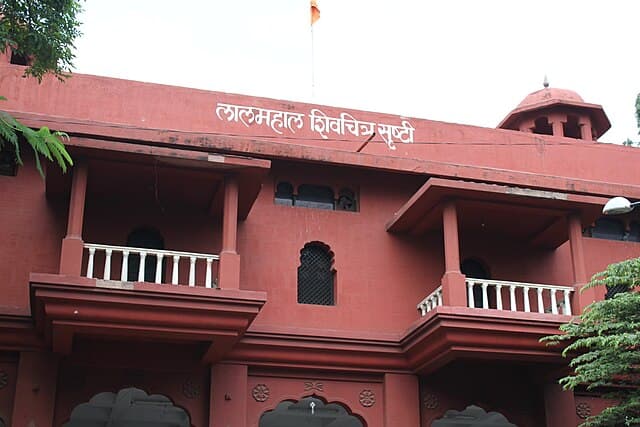
Tucked in the busy lanes of Pune's old city, not far from the towering gates of Shaniwar Wada, stands a modest red-brick building that carries an outsized share of Maratha history. This is Lal Mahal — the Red Palace — a place every history-loving traveler to Pune should walk through at least once. It isn't grand in scale compared to the forts and citadels the Marathas would later build across the Sahyadris, but its significance lies in what happened here: this is where a young boy named Shivaji grew into the leader who would go on to found the Maratha Empire.
Lal Mahal's story begins in the early 1600s. Pune at the time was a town recovering from destruction, and the task of reviving it fell to Shahaji Bhosale, a powerful jagirdar of the region and father of Shivaji. Around 1630, Shahaji had Lal Mahal constructed as a residence for his wife, Jijabai, and their young son. The idea was as much administrative as personal — a functioning household in the heart of a town being rebuilt from ruin, meant to signal renewed life and order in Pune.
It was here that Jijabai raised Shivaji, and it was here, under the guidance of his mother and his mentor Dadoji Kondadeo, that the young prince absorbed the lessons that would shape his future. Stories describe Jijabai narrating tales from the Ramayana and Mahabharata to instill in Shivaji a sense of duty, courage, and justice — values that would later define his rule. Shivaji is said to have lived at Lal Mahal until around 1645, the year he captured the fort of Torna, marking the true beginning of his military career and the Maratha resistance against the Adilshahi and Mughal powers.
No account of Lal Mahal is complete without its most famous episode — the daring nighttime raid on the Mughal general Shaista Khan. During the Mughal occupation of Pune in the 1660s, Shaista Khan had taken up residence in Lal Mahal itself, using the very palace where Shivaji had grown up as his headquarters. In a bold and now-legendary act, Shivaji infiltrated the heavily guarded palace with a small band of men and confronted Shaista Khan in his private quarters. In the chaos, Shaista Khan tried to flee through a window, and Shivaji struck at him, severing his fingers as the general narrowly escaped with his life.
The raid was a stunning act of audacity — striking at a Mughal general inside a fortified residence, in a town under Mughal control — and it became one of the defining stories of Shivaji's guerrilla strategy, a mix of local knowledge, surprise, and sheer nerve. It remains one of the most retold tales in Maratha history and is central to why Lal Mahal is remembered as much for its drama as for its domestic history.
Here's a detail many visitors don't expect: the Lal Mahal standing today is not the original structure. The palace changed hands and suffered damage over the decades of conflict that followed Shivaji's era, and eventually fell into disrepair. According to local accounts, when the Peshwas later built Shaniwar Wada nearby in the 18th century, some bricks and stones from the old Lal Mahal were incorporated into the new fort — not purely out of practicality, but as a gesture believed to carry good fortune forward.
For a long time afterward, little remained of the original palace beyond fragments and memory. It wasn't until the 1980s that the Pune Municipal Corporation took up the project of reconstructing Lal Mahal on part of its original site, using historical references to recreate its spirit rather than an exact replica. The rebuilding began in 1984 and was completed in 1988, giving Pune the red-walled memorial that stands today.
The present-day Lal Mahal functions as a memorial and small museum rather than a lived-in palace, and it's compact enough to explore in under an hour. Walking through, you'll find:
The building itself is simple — a red-painted, multi-storeyed structure with an unassuming facade — but that simplicity is part of its charm. It doesn't try to overwhelm visitors with scale; instead, it invites a quieter reflection on where a legendary figure's story actually began.
Since Lal Mahal is so centrally located, it pairs naturally with a broader walk through old Pune's historic core:
Lal Mahal isn't remembered for grandeur or scale — plenty of Maharashtra's forts dwarf it in size and drama. Its importance lies elsewhere: it's the place where the ideas of Swarajya, self-rule, first took root in a young boy's mind, shaped by his mother's stories and his mentor's guidance. It's also the site of one of the most audacious acts of resistance in Maratha history, carried out by a man who had once played in these very courtyards as a child.
For visitors to Pune, spending even thirty quiet minutes at Lal Mahal offers something most bigger monuments can't: a sense of the human beginnings behind a legend — the household, the mother, the lessons — before the forts, the battles, and the empire that followed.